What Is Vector Conversion? A Complete Beginner’s Guide
Have you ever tried to print a logo only to find it blurry or pixelated? This happens because not every image is made for professional printing. If you want sharp artwork for embroidery, custom patches, signs, or promotional products, you need a vector file.
Many people hear the term “vector conversion” but are not sure what it means. The good news is that it is easy to understand. In this guide, you’ll learn what vector conversion is, how it works, why it matters, and when you should use it. By the end, you’ll know why businesses rely on vector artwork for high-quality results.
What Is Vector Conversion?
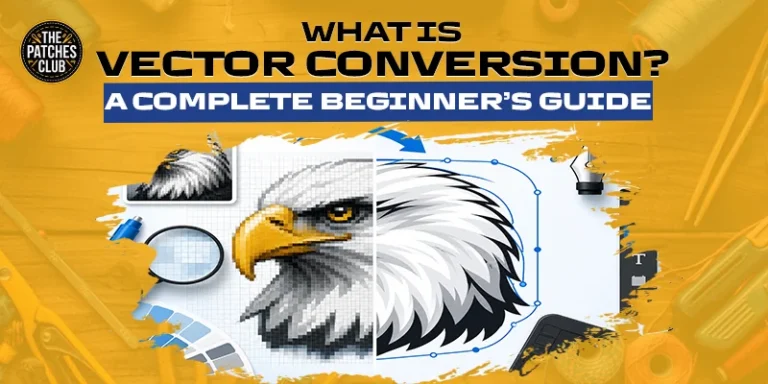
Vector conversion is the process of changing a raster image into a vector file. A raster image is made of tiny pixels, while a vector image is created using paths, lines, and curves. Instead of depending on pixels, vector files use mathematical points to build artwork.
This means the design stays sharp no matter how large or small it becomes. Professional designers often change logos, icons, text, and illustrations into vector format before printing or embroidery. If you need precise embroidery files with clean stitching and professional results, consider our Custom Digitizing Service.
Design Your Custom Patches Right Now!
Raster vs Vector Images
Understanding the difference between raster and vector images is the first step. Raster images include formats like JPG, PNG, GIF, and BMP. These files work well for photographs but lose quality when enlarged. The edges become blurry because the pixels stretch.
Vector files include AI, EPS, SVG, and PDF. They can be resized without losing quality because they are made from paths instead of pixels. If your logo needs to appear on a business card today and a large banner tomorrow, a vector file is the right choice.
Why Is Vector Conversion Important?
Vector conversion helps keep artwork clean and professional across different products. A high-quality vector file helps printers and embroidery experts use precise artwork. Every line, curve, and shape stays clear even at large sizes.
Without vector conversion, logos may appear fuzzy, uneven, or difficult to reproduce correctly. This can affect your brand image and lead to poor-quality products.
How Does Vector Conversion Work?
Vector conversion starts with an existing image. This could be a logo, sketch, badge, or graphic. A professional designer traces the artwork using vector software. Every shape is recreated using smooth lines and curves instead of pixels.
Colours, spacing, and proportions are carefully matched to the original design. The finished file is then saved in a vector format that is ready for printing, cutting, engraving, or embroidery.
Common Vector File Formats
Several file formats are used for vector artwork. AI files are commonly used in Adobe Illustrator and are popular with graphic designers. EPS files are widely accepted by printing companies because they work with many design programs.
SVG files are often used for websites, digital graphics, and cutting machines. PDF files can hold vector artwork if exported properly. This makes them great for sharing print-ready designs. Each format serves a different purpose, but they all keep artwork sharp and scalable.
Where Is Vector Conversion Used?
Vector artwork is used in many industries because it delivers consistent quality. Printing companies use vector files for business cards, brochures, banners, and packaging. Embroidery digitizers usually ask for vector logos before making embroidery files. This is because vector art is easier to work with.
Sign makers rely on vector graphics for vehicle wraps, shop signs, and window displays. Promotional product companies also use vector files for mugs, pens, bags, and branded merchandise. If you want crisp, scalable artwork for printing, branding, or embroidery, consider our Vector Conversion Service.
Benefits of Vector Conversion
One of the biggest benefits is unlimited resizing. Whether the design is printed on a small label or a large billboard, it remains crisp. Vector files also produce cleaner printing because the lines stay smooth and accurate.
Editing is another major advantage. Colours, text, and shapes can be changed without reducing image quality. Since vector artwork works with many printing methods, it is a valuable file to keep for future branding projects.
Can Vector Conversion Be Done Automatically?
Some software offers automatic vector conversion with a single click. While this may work for simple artwork, the results are often inconsistent. Small details can be missed, curves may become uneven, and text may lose its original appearance.
Professional manual vector conversion creates cleaner artwork. Each element is checked and adjusted carefully. If your logo represents your business, professional conversion is usually the better choice.
When Do You Need Vector Conversion?
You should consider vector conversion whenever you plan to print or embroider your design. If you only have a JPG or PNG logo, converting it to a vector file helps prepare it for professional production.
It’s also great for creating custom patches, uniforms, signs, stickers, promotional items, clothes, or marketing materials. Having a vector version of your logo saves time whenever you need new branded products.
Common Mistakes to Avoid
Many people believe increasing the size of a JPG will improve its quality. Unfortunately, it only makes the pixels larger. Another mistake is using low-resolution artwork for professional printing.
Even if it looks acceptable on a computer screen, it may not print clearly. Choosing automatic conversion for detailed logos can also lead to poor results. Professional vector conversion provides a much cleaner finish.
How to Choose a Reliable Vector Conversion Service
A good vector conversion service should focus on accuracy, quality, and fast delivery. Seek designers with experience who recreate artwork by hand, not just with software. They must give you the files in the formats you need. Also, ensure the design is ready for printing or embroidery.
A trusted company will also offer quick turnaround times and friendly customer support if changes are needed. If you need bright, durable transfers for high-quality garment printing, consider our DTF Transfers Service.
Why Choose The Patches Club?
At The Patches Club, we offer vector conversion services. We help businesses, sports teams, clothing brands, and organisations throughout the UK. Our skilled designers carefully recreate each logo.
They ensure the lines are clean, colours are true, and the artwork is ready for printing or embroidery. We provide top-notch vector files quickly. This helps you keep your project on track without delays.
If you need artwork for custom patches, uniforms, promotional products, or large-format printing, our team is ready to help. Get your free quote today. We’ll prepare your artwork for amazing results.
Conclusion
Vector conversion is an important step for anyone who wants professional-quality artwork. Unlike raster images, vector files stay sharp at any size and are easy to edit for future projects.
A vector file provides clear and consistent results for custom patches, embroidered clothing, business signs, and printed products. Using a professional vector conversion service gives you ready-to-use artwork. This helps your brand shine every time.
FAQs
Frequently Asked Questions
Vector conversion creates scalable artwork that stays sharp for printing, embroidery, and branding.
Yes, a PNG can be professionally converted into a clean vector file for high-quality use.
Printing, embroidery, signage, apparel, promotional products, and graphic design all use vector files.
AI, EPS, SVG, and vector PDF are the most commonly used formats.
It recreates your logo as scalable artwork, making it suitable for professional production.
Yes, vector files help create accurate patch designs and cleaner embroidery results.
Most vector conversion projects are completed within 24 hours, depending on the artwork.
Yes, hand-drawn sketches and illustrations can be converted into editable vector files.
Yes, colours, shapes, and text can be edited without reducing image quality.
Yes, colours, shapes, and text can be edited without reducing image quality.
How to Remove Iron-On Patches: A Comprehensive Guide
Iron-on patches are a simple way to customise jackets, shirts, bags, uniforms, and other items. But what happens when you…
How to Apply Iron On Patches: A Step-by-Step Guide
Want to give an old jacket, bag, or pair of jeans a fresh look? Iron on patches are one of…
10 Best Custom Patch Companies in the UK 2026
Need custom patches in the UK but unsure which company to choose? The right patch maker can turn your logo,…